

Overview
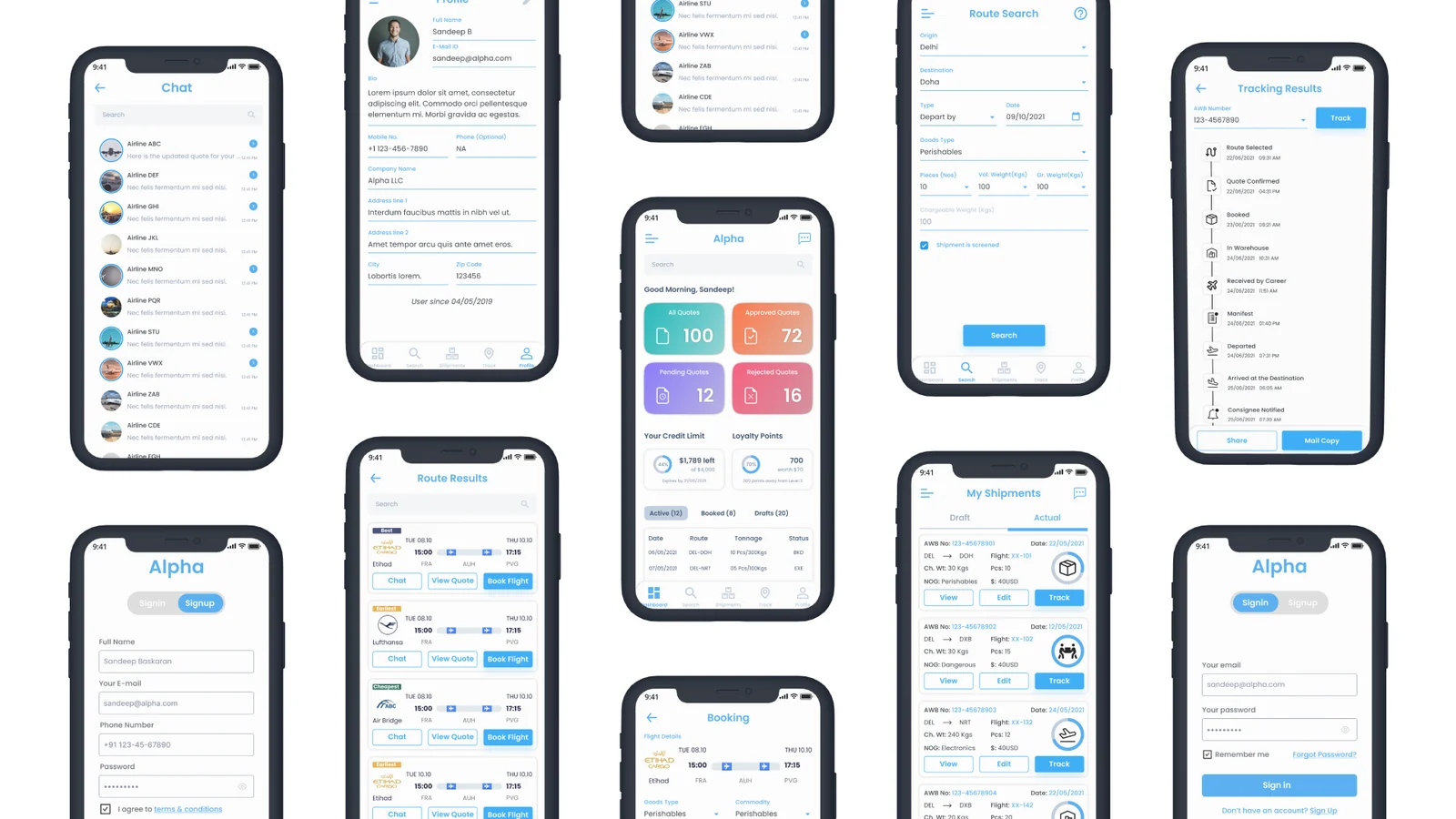
Alpha is a mobile platform for air cargo professionals — freight forwarders, airlines, and General Sales Agents (GSAs) — to book shipments in a few taps, compare quotes across carriers, track the full lifecycle of a shipment in real time, and resolve shipment issues over chat. A single dashboard surfaces shipment analytics, loyalty points, credit limits, and active quotes for faster data-driven decisions.
The problem
Air cargo professionals had no shortage of software, but almost all of it was desktop-bound. Booking a shipment, comparing airline trade rates, or checking a consignment's status meant sitting at a workstation and navigating legacy web portals.
The goal of this two-week sprint was to bring five core air cargo workflows into a clean mobile experience:
- Book cargo in a few clicks.
- Track the complete lifecycle of a shipment from acceptance to delivery.
- Resolve cargo queries through a simple in-app chat with executives.
- Compare quotes across airlines and decide on the spot.
- See shipment analytics on a single screen.
Process & timeline
I structured the two-week sprint across five stages — Empathize, Define, Ideate, Design, and Prototype — using Figma, Balsamiq, and Adobe Illustrator.
01 · Empathize — industry & competitive research
Because I had already worked in the air cargo domain, I leaned on direct domain experience alongside secondary statistical, behavioural, and competitive research rather than starting from zero with introductory surveys.
- Statistical research (App Annie): COVID-19 accelerated digital adoption across logistics, with a sharp rise in mobile app downloads across both Android and iOS before vs. after the pandemic.
- Behavioural research: Mobile app usage consistently outpaced browser and desktop sessions year over year as field and warehouse operators moved away from fixed desks.
- Competitive analysis: I evaluated leading air cargo marketplaces including Cargo.one and Cargo AI. While several competitors modernised rate discovery and booking, their workflows remained desktop-first, leaving a clear gap for a mobile-native companion.
02 · Define — 5Ws, empathy map & journey map
"If I were given one hour to save the world, I would spend 59 minutes defining the problem and one minute solving it." — Albert Einstein
I framed the problem around the 5Ws:
| Question | Framing |
|---|---|
| Who | Freight Forwarders, Airlines, and GSAs (General Sales Agents) who want to cut the time spent on repetitive cargo booking and tracking steps. |
| What | A simplified, end-to-end air cargo mobile experience covering booking, e-quotes, tracking, chat, and analytics. |
| When | As the industry shifts from paper and desktop portals to mobile-first operations. |
| Where | Across each handoff of the air cargo supply chain — rate search, booking, transit tracking, and exception handling. |
| Why | So cargo professionals can book in a few steps, compare carrier quotes in one place, and resolve shipment queries without waiting to get back to a desk. |
03 · Ideate — user flow
I mapped the core architecture into five connected modules: Booking, e-Quote generation, Track, Chat, and Dashboard.
04 · Design — heuristics, sketches, wireframes & UI
Heuristic principles applied
- Visibility of system status: The tracking module notifies the user in real time at every milestone of the shipment lifecycle.
- Match between system and the real world: Call-to-action labels use plain, direct language rather than dense cargo jargon.
- User control and freedom: Once a booking is completed, users have an immediate, clear path back to the home dashboard.
Sketches & Balsamiq wireframes
I translated the user flows into rough paper sketches to explore layout density, then built low-fidelity wireframes in Balsamiq to lock in the information hierarchy before moving into high-fidelity UI.
Onboarding & authentication
Onboarding introduces the five core jobs of the app — flight booking, invoicing and quotes, live location tracking, mobile inbox support, and visual analytics — before dropping into a clean email-and-password sign-in flow.
Core mobile screens & style guide
- Home dashboard: Surfaces the latest shipment status, loyalty points, credit limit, and quote summary at a glance.
- Search & booking: Enter shipment dimensions, origin, and destination to compare flights and either book directly or request a quote.
- Lifecycle tracking: Follow a consignment from acceptance to final delivery.
- Executive chat & profile: Resolve shipment exceptions inline and manage account details.
05 · Prototype & learnings
Key learnings
- Low-fidelity wireframes paid for themselves. Iterating in Balsamiq first made structural trade-offs cheap before committing to high-fidelity screens.
- Front-loaded research sped up prototyping. Having the domain model, 5Ws, and user flows locked meant assembling the interactive prototype took minutes rather than days.
- Design system thinking scales even on a two-week sprint. Defining reusable colour, type, and card primitives early kept every module visually consistent.